← Portfolio
SENTINAL LIVE
EW1 — 4 EMITTERS TRACKED | MISSION: COMBAT_AIR_PATROL — THREAT: HIGH | COMINT NET_A ACTIVE | RADAR CLASSIFIER ACCURACY: 95.4% | KAFKA BROKER: ONLINE | POSTGRESQL: CONNECTED | EW2 — 8 EMITTERS TRACKED | FIGHTER JETS DETECTED: 3 | JAMMING EVENT: t=150-170 | EOB UPDATED | SIGINT CORRELATION: 0.87 | 50+ REST ENDPOINTS ACTIVE | EW1 — 4 EMITTERS TRACKED | MISSION: COMBAT_AIR_PATROL — THREAT: HIGH | COMINT NET_A ACTIVE | RADAR CLASSIFIER ACCURACY: 95.4% | KAFKA BROKER: ONLINE | POSTGRESQL: CONNECTED | EW2 — 8 EMITTERS TRACKED | FIGHTER JETS DETECTED: 3 | JAMMING EVENT: t=150-170 | EOB UPDATED | SIGINT CORRELATION: 0.87 | 50+ REST ENDPOINTS ACTIVE |

Electronic Warfare Intelligence

SENTINAL Signal Intelligence

Real-time, multi-sensor military intelligence platform
detecting, classifying, tracking and analysing
adversary radar emitters and communications networks.

ELINT COMINT SIGINT Fusion Machine Learning Real-Time Kafka Streaming
300Timesteps
50+REST APIs
12Intel Panels
95%+RF Accuracy

01 — Overview

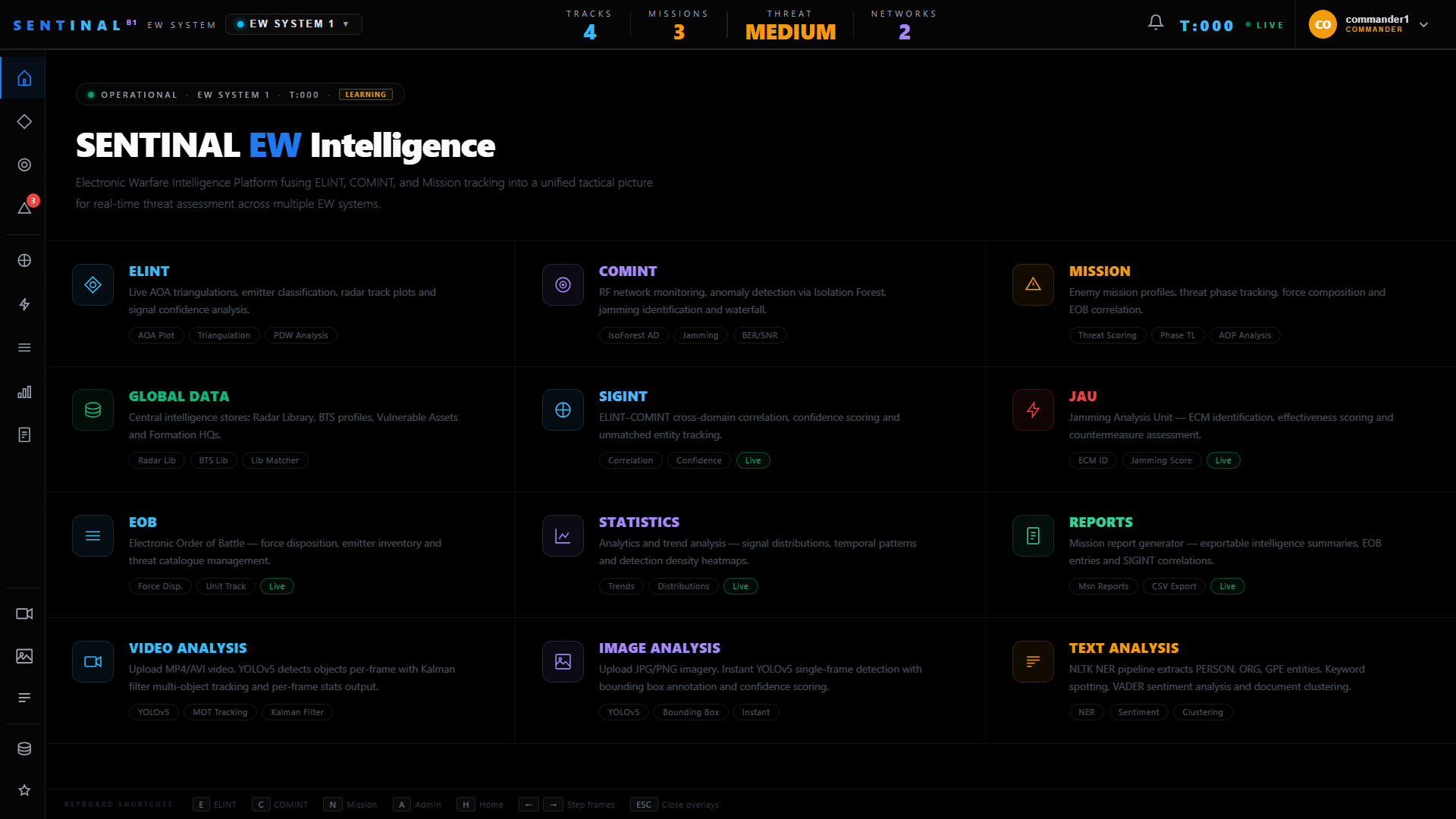
What is SENTINAL?

A full-stack Electronic Warfare Analysis System built from the ground up — from synthetic sensor data generation through machine learning classification to a tactical intelligence dashboard.

ELINT Collection

Detects, locates, and classifies adversary radar emitters using passive RF sensing across a 100x100 km tactical grid. Four geographically distributed sensors per EW system capture pulse descriptor words with realistic Gaussian noise models including freq, PRI, PW, AoA, and Doppler shift.

COMINT Analysis

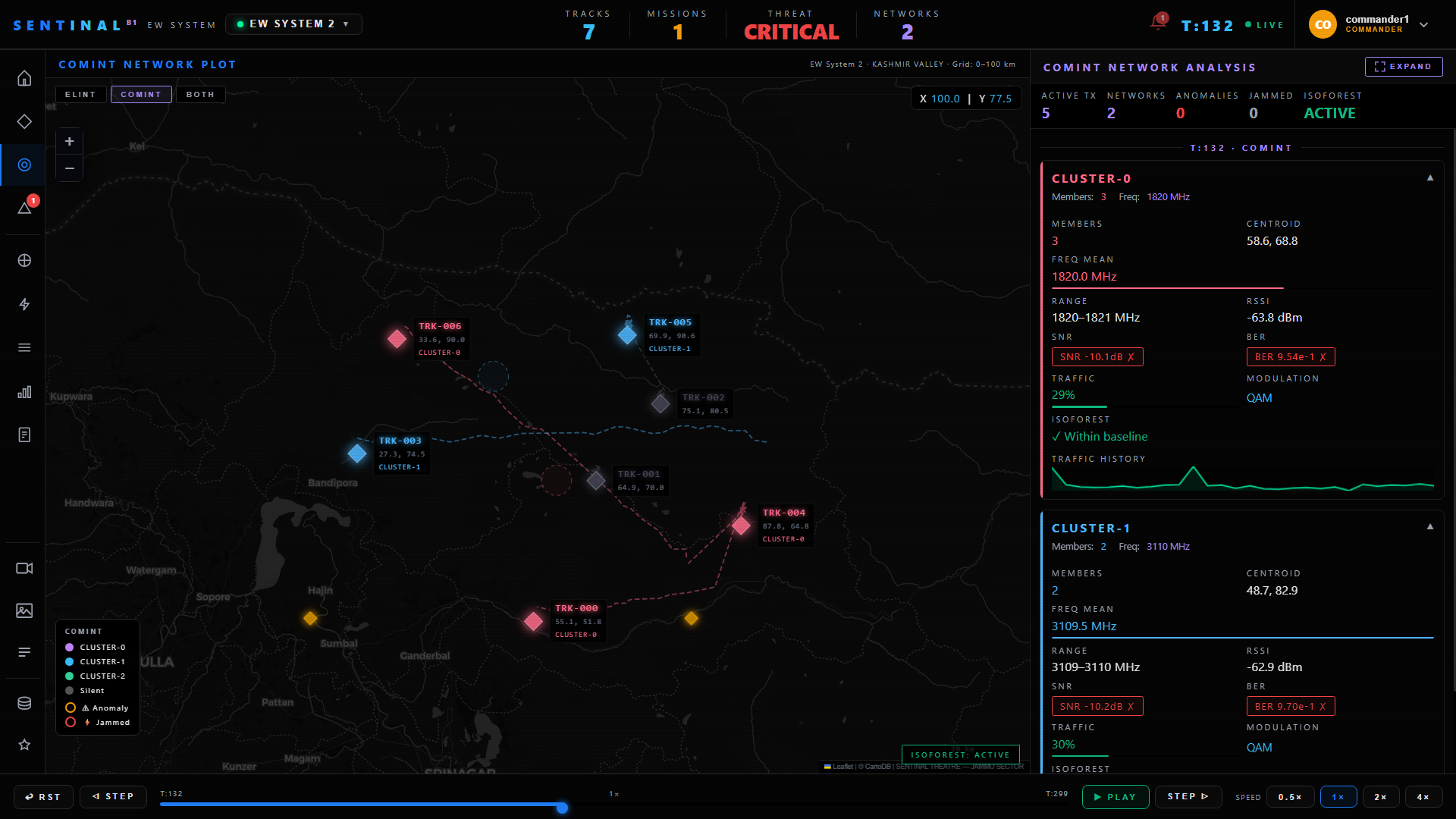
Monitors adversary communication networks across VHF, UHF and S-Band frequencies. Detects frequency hopping, jamming events, and network blackouts. Online Isolation Forest provides adaptive anomaly detection that learns the baseline distribution in real time across the first 25 timesteps.

SIGINT Correlation

Cross-correlates ELINT tracks with COMINT network clusters using a composite scoring system evaluating spatial colocation, frequency band match, and co-jamming signatures. Pairs scoring 0.65+ are flagged as likely same platform, revealing radar-equipped command units.

Mission Management

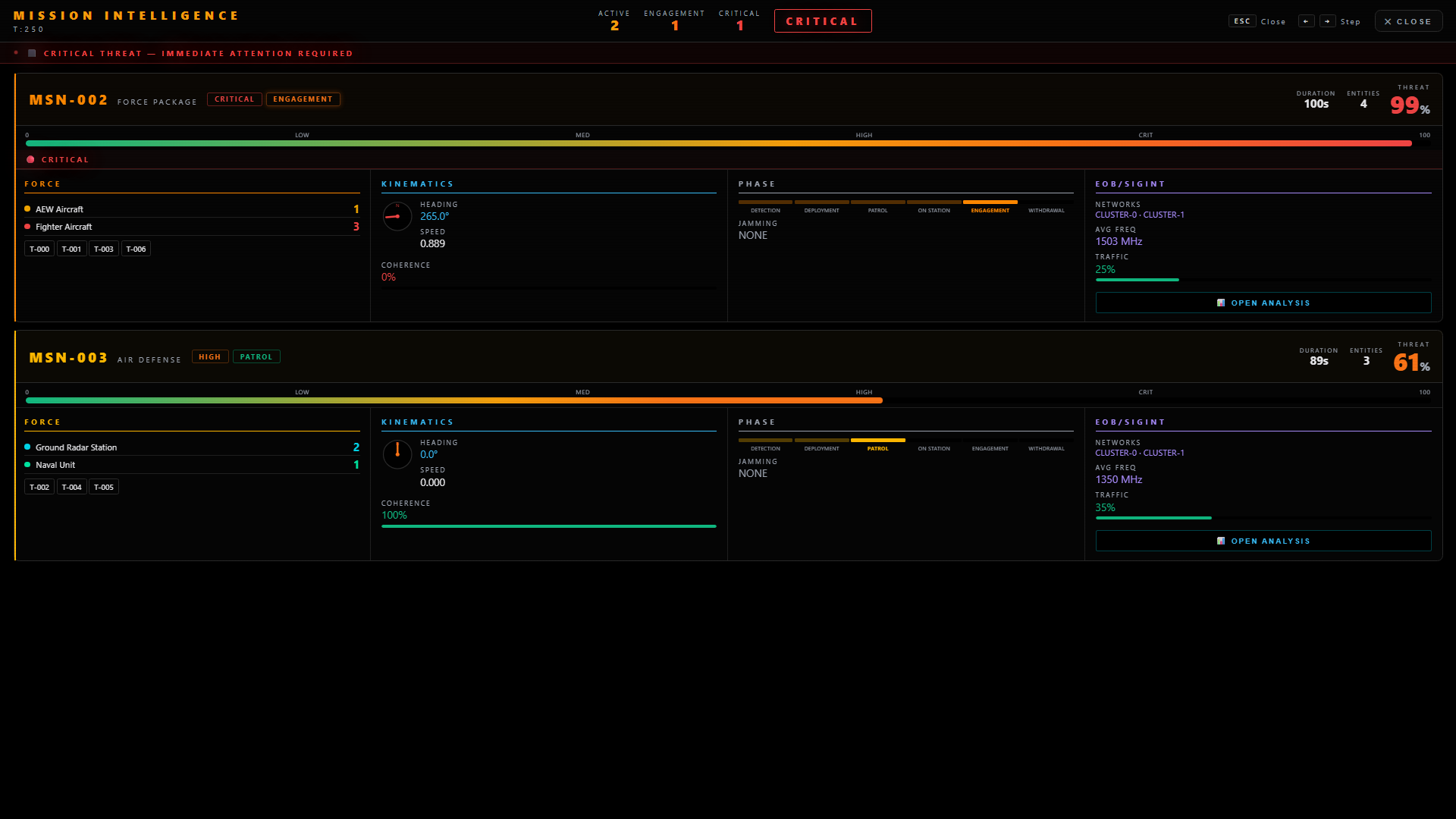
Automatically detects, classifies, and tracks 10 adversary tactical mission types including STRIKE_PACKAGE, COMBAT_AIR_PATROL, and ELECTRONIC_WARFARE. Threat scores (0.0-1.0) computed from a weighted formula across entity count, speed, jamming, and heading coherence.

Common Operating Picture (COP)

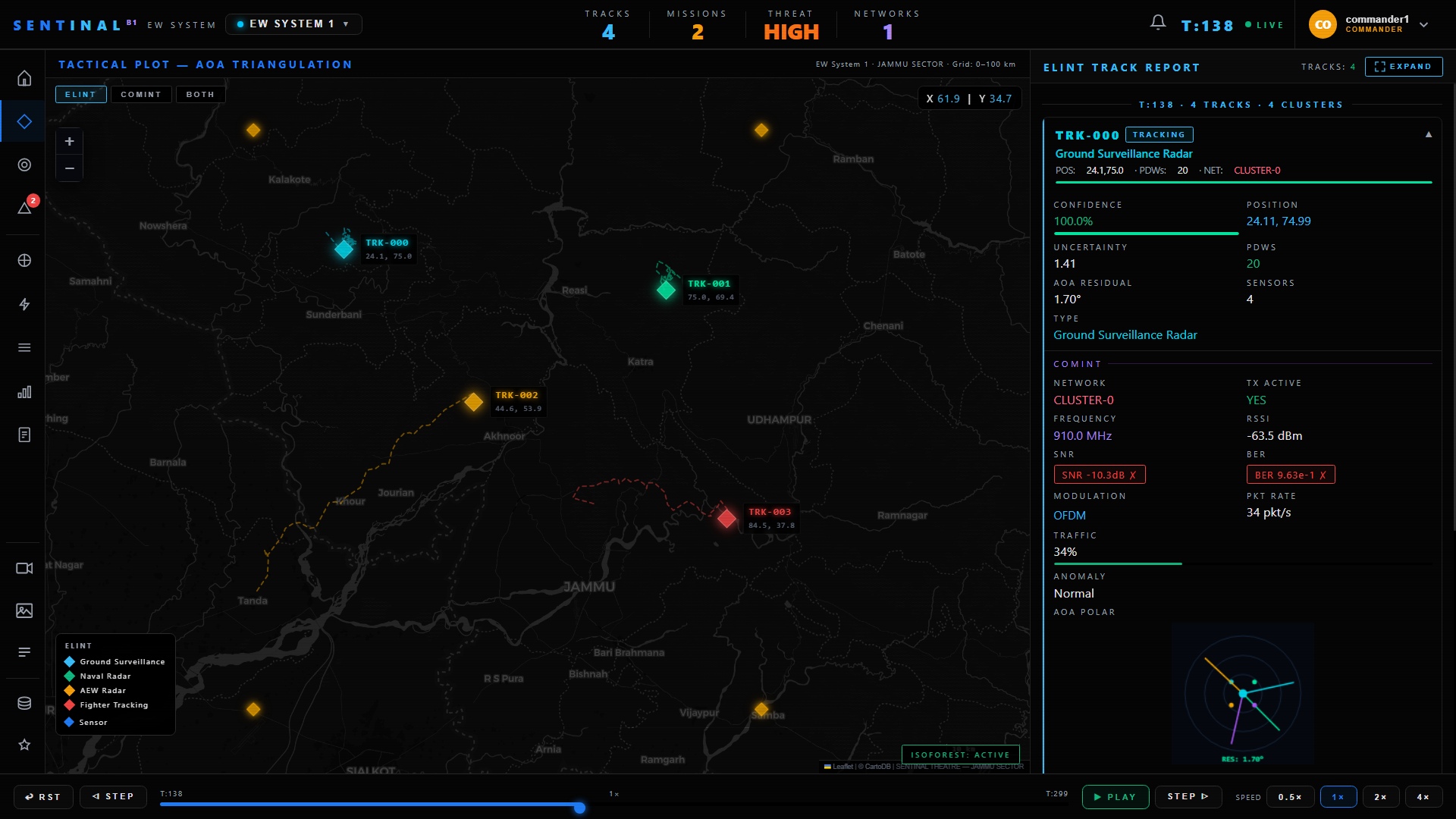
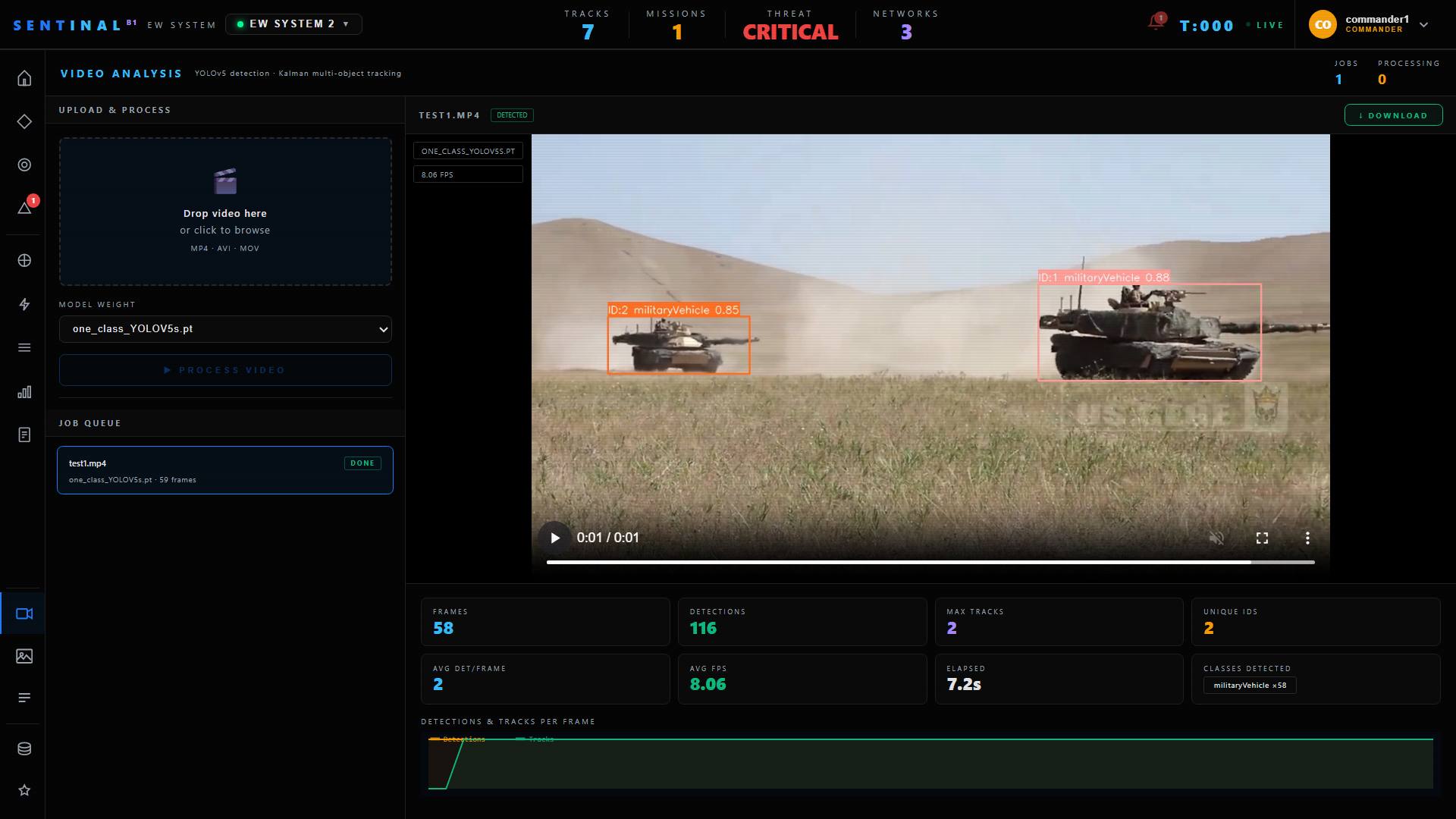
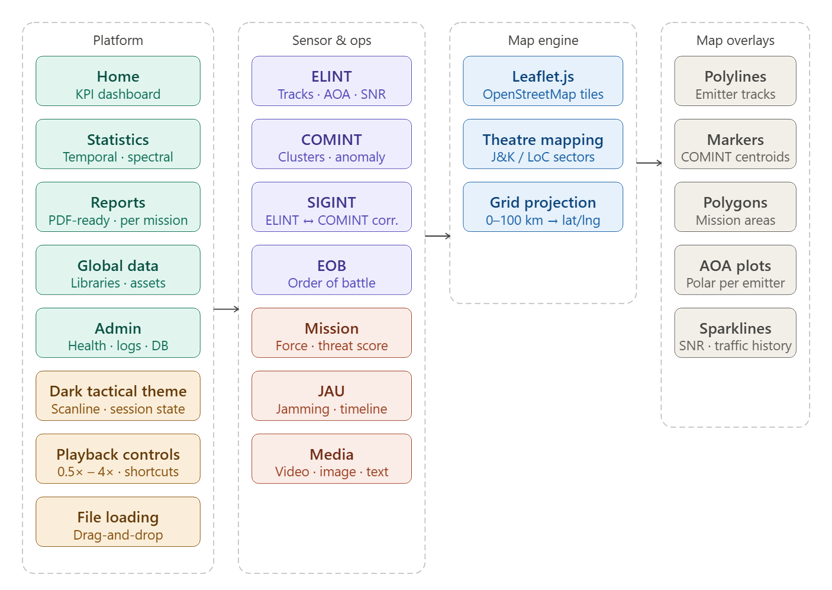
A unified timestamped situational display integrating sensor data, Kalman-tracked emitter trails, COMINT network statistics, Electronic Order of Battle, SIGINT correlation pairs, jamming analysis (JAU), and a Media Intelligence pipeline with YOLOv5 video object detection and NLP text analysis — all served through 50+ REST API endpoints to a vanilla JS tactical dashboard with a dark military-grade aesthetic including scanline overlay, CRT typography, and FEBA boundary rendering.

02 — Capabilities

Full Capability Matrix

Every intelligence function, the technology powering it, and its tactical output to the operator.

CapabilityTechnologyOutput
Radar Emitter DetectionDBSCANPDW ClusteringEmitter positions (x,y) with uncertainty bounds from sensor fusion
Radar ClassificationRandom Forest300 Trees4 radar types: GS / Naval / AEW / Fighter + confidence score
Position EstimationAoA TriangulationLeast-SquaresGeolocated emitter coordinates from multi-sensor angle bearings
Track ContinuityKalman FilterConstant VelocitySmoothed tracks [x,y,vx,vy] with prediction and trail history
COMINT ClusteringAgglomerative120 MHz thresholdNetwork groups with SNR, BER, traffic load, modulation stats
Anomaly DetectionIsolation ForestOnline LearningFlagged anomalous transmissions vs 25-timestep learned baseline
Mission DetectionRule-Based ClassifierMulti-CriterionNamed missions with threat scores mapping to LOW/MEDIUM/HIGH/CRITICAL
SIGINT CorrelationSpatial + Freq ScoringRadar-COMINT platform associations flagged at score >= 0.65
Video IntelligenceYOLOv5Kalman Box TrackerObject-tracked annotated H.264 video with persistent track IDs
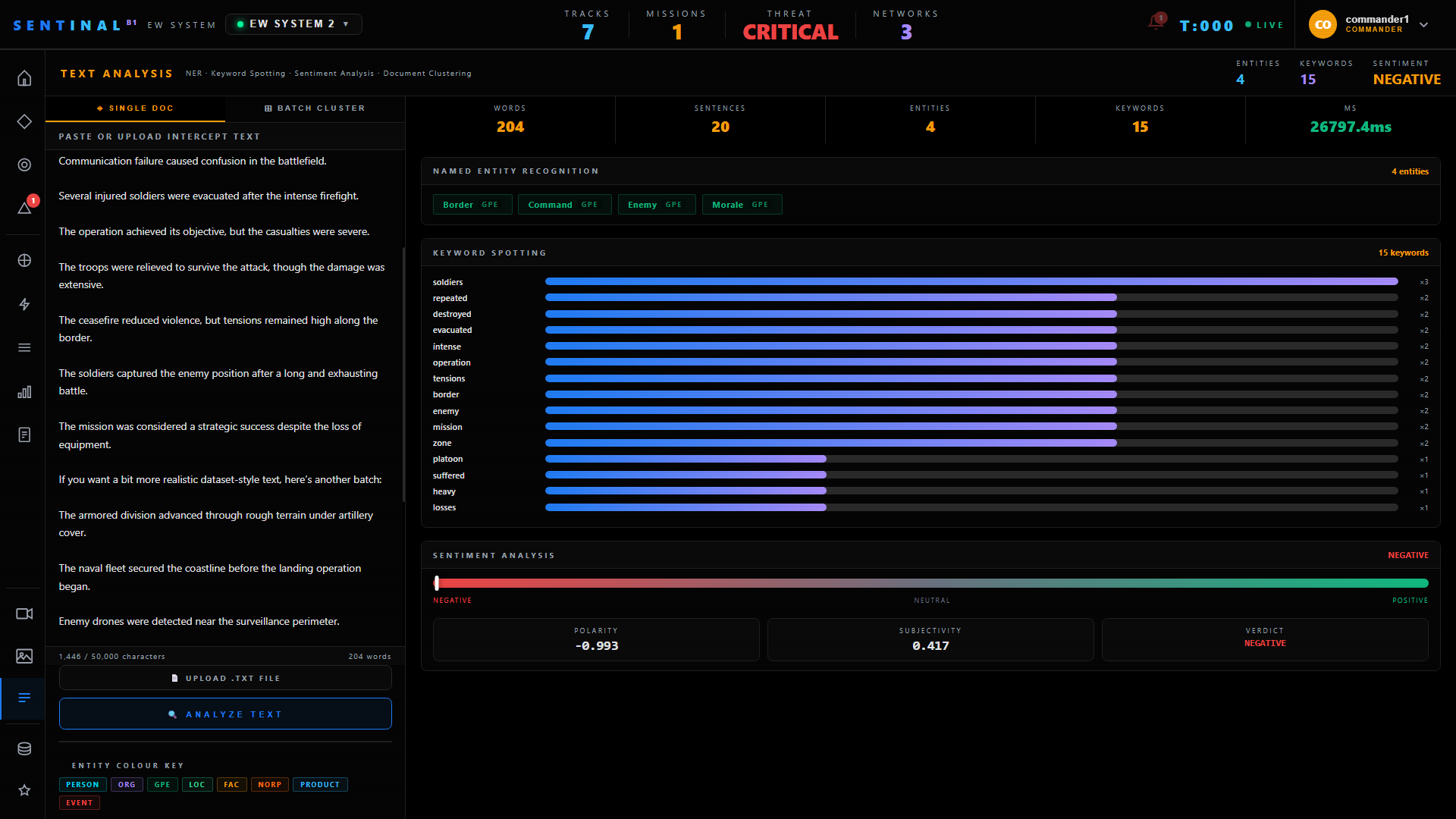
Text IntelligenceNLTK NERVADER SentimentNamed entities, frequency-ranked keywords, compound sentiment scores
Jamming Analysis (JAU)Pre/Post-Jam ComparisonJamming effectiveness score, SNR degradation, recovery time estimate
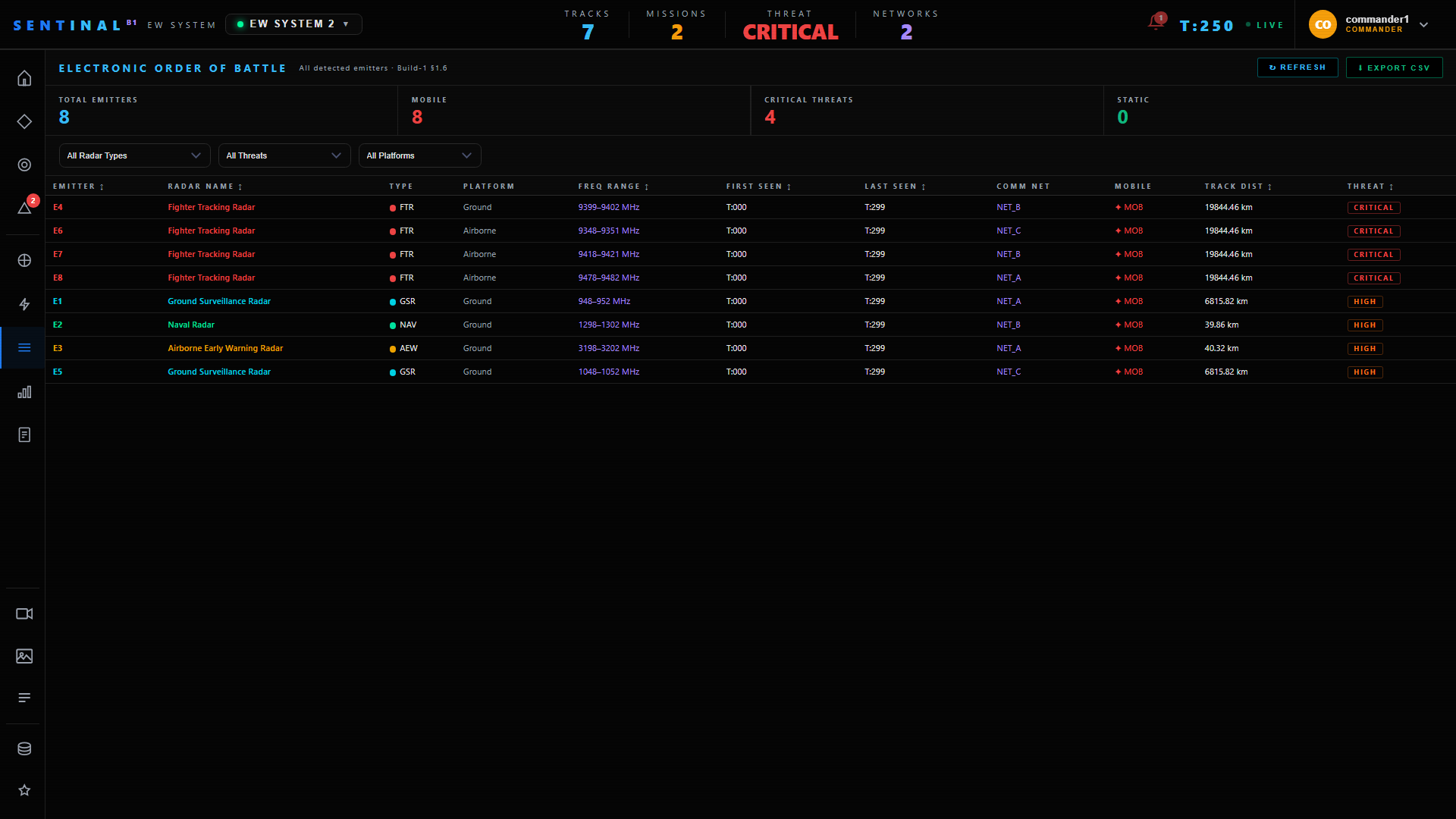
Electronic Order of BattleEOB BuilderFull AggregationPer-emitter intelligence picture across all 300 simulation frames

03 — Architecture

5-Layer System Architecture

A pipeline architecture where sensor data flows from synthetic generation through Kafka streaming, ML intelligence processing, PostgreSQL persistence, and out to the tactical dashboard.

LAYER 01
Data Generation
Python / NumPy / Pandas
Synthetic EW sensor CSV generation. 300 timesteps at DT=1s. Realistic Gaussian noise. Scripted tactical events (jamming, anomaly, blackout).
LAYER 02
Kafka Streaming
Apache Kafka / Docker
Real-time message broker on ew1.raw + ew2.raw topics. 20MB message limit. Timestamp-grouped JSON batches. Decouples producer from consumer.
LAYER 03
Intelligence Engine
Flask / scikit-learn / NumPy
9-step ML processing pipeline per frame — DBSCAN, Random Forest, AoA triangulation, Kalman tracking, COMINT clustering, mission management.
LAYER 04
PostgreSQL
PostgreSQL / psycopg2
3-table JSONB schema: frames, system_summaries, analysis_cache. Bulk upsert with execute_values at page_size=200 for efficiency.
LAYER 05
Dashboard + Adaptor
Vanilla JS / HTML / CSS
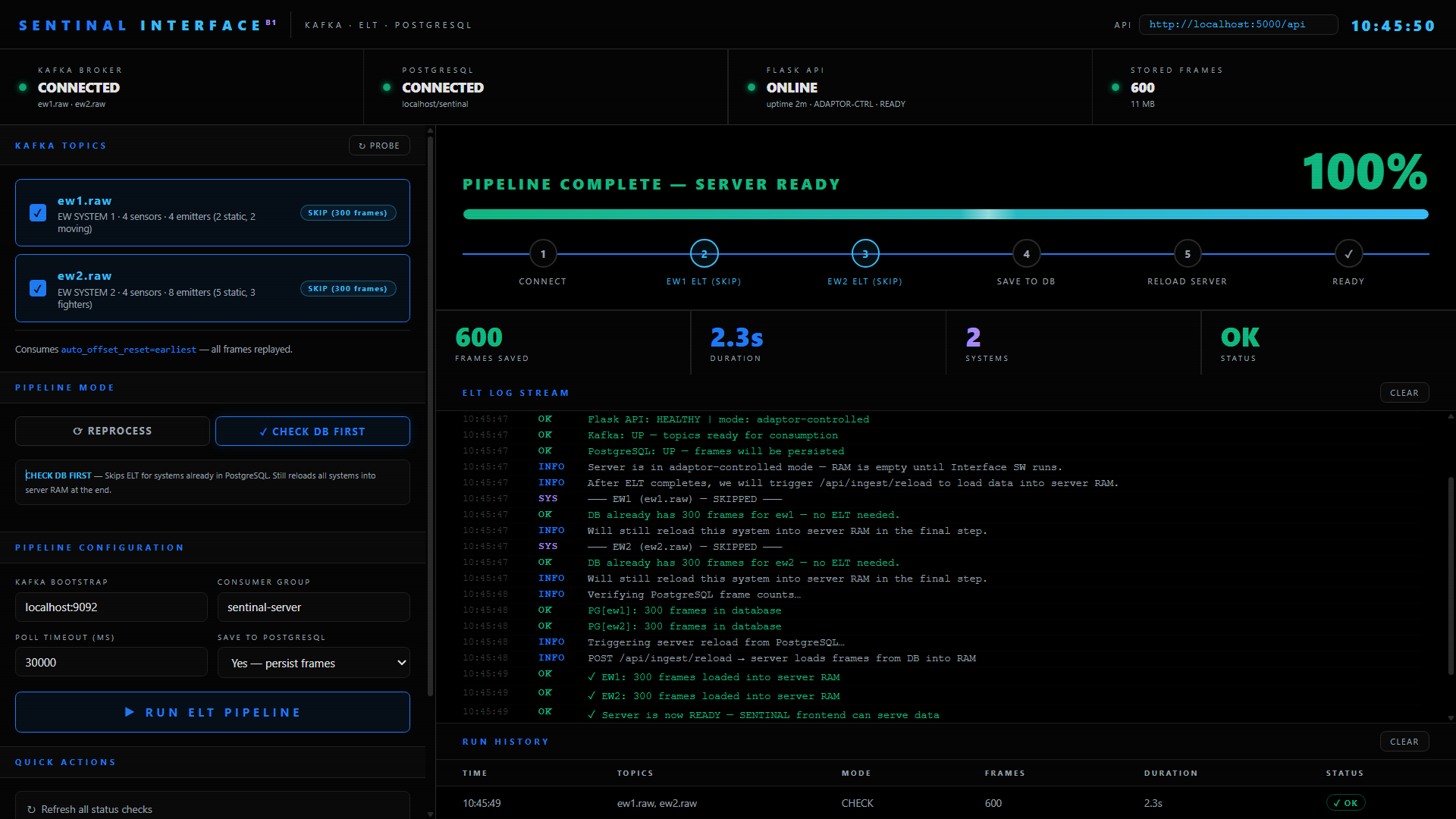
Tactical COP dashboard (index.html) + ICIC Interface Software (adaptor.html) for operator-controlled ELT pipeline execution.

Dual EW System Configuration

EW System 1

Sensors at map corners for maximum AoA coverage. 4 emitters: 2 static, 1 moving AEW on sinusoidal racetrack orbit, 1 fighter. 2 COMINT networks (NET_A VHF ~890MHz, NET_B UHF ~1800MHz). Display colour: cyan. DBSCAN epsilon: 0.3, association: 15km.

EW System 2

Trapezoid sensor layout for asymmetric realistic coverage. 8 emitters including 3 fighter jets moving diagonally at 0.3-0.4 km/s. 3 COMINT networks (+NET_C S-Band ~3100MHz). Display colour: green. PDW signatures tuned to match EW1 classifier training distribution.
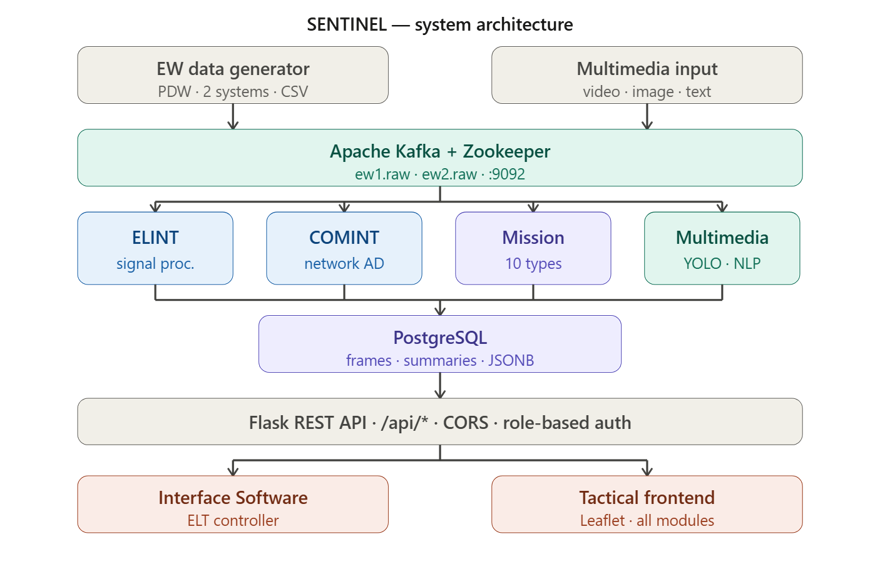
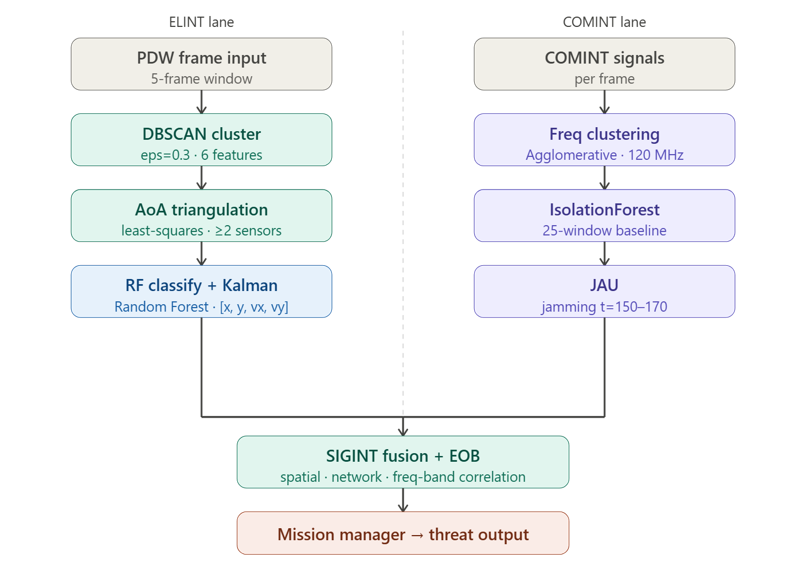
System Architecture Diagram
End-to-End Data Flow

04 — Interface

Tactical Dashboard

A dark military-grade single-page application with 12 intelligence panels, scanline overlay, CRT-style typography, and frame-by-frame or auto-play navigation through 300 timesteps.

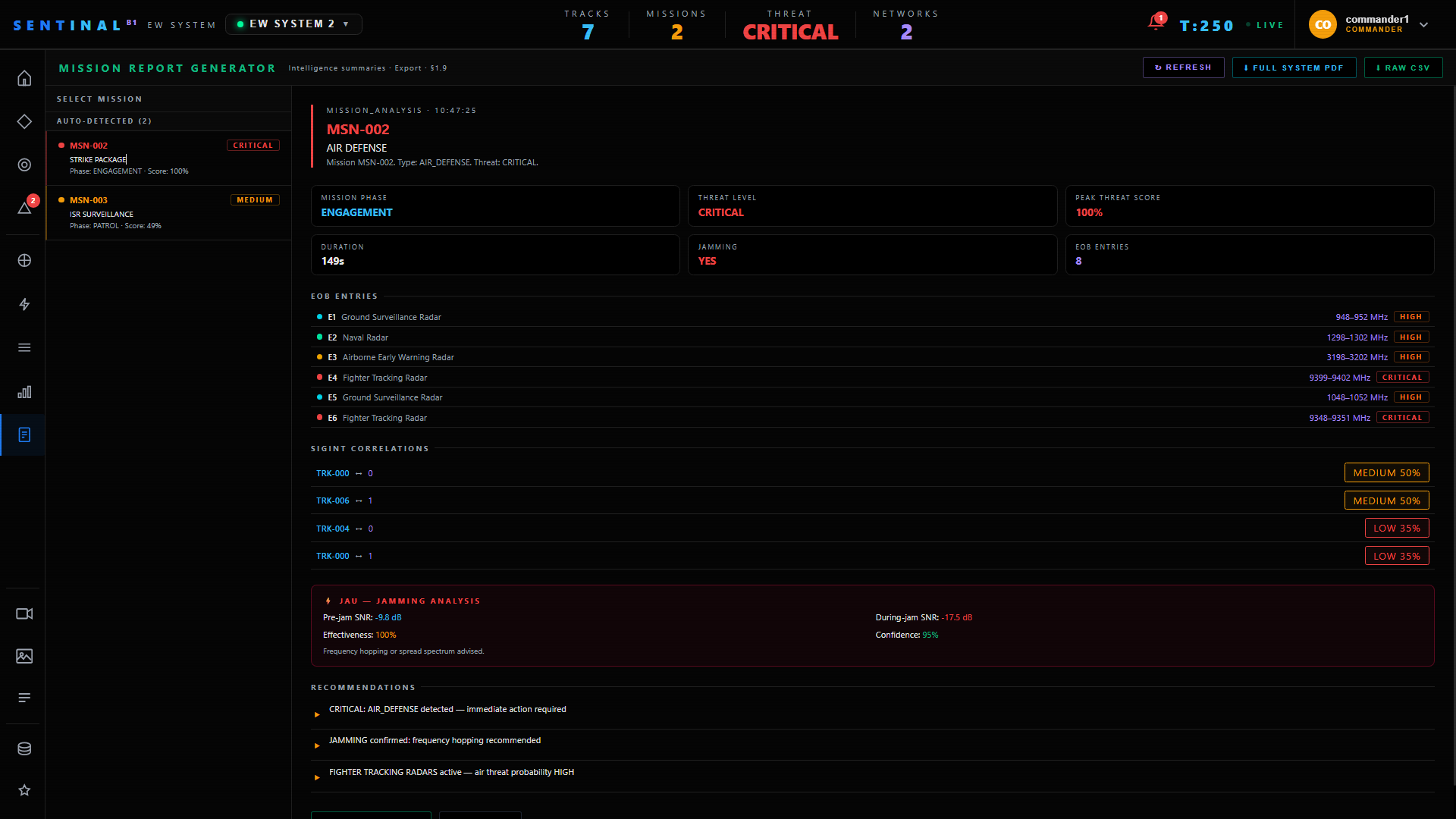
Electronic Order of Battle
SIGINT Correlation Panel
JAU Jamming Analysis
Media Intelligence — YOLOv5 Video
ICIC Adaptor Interface
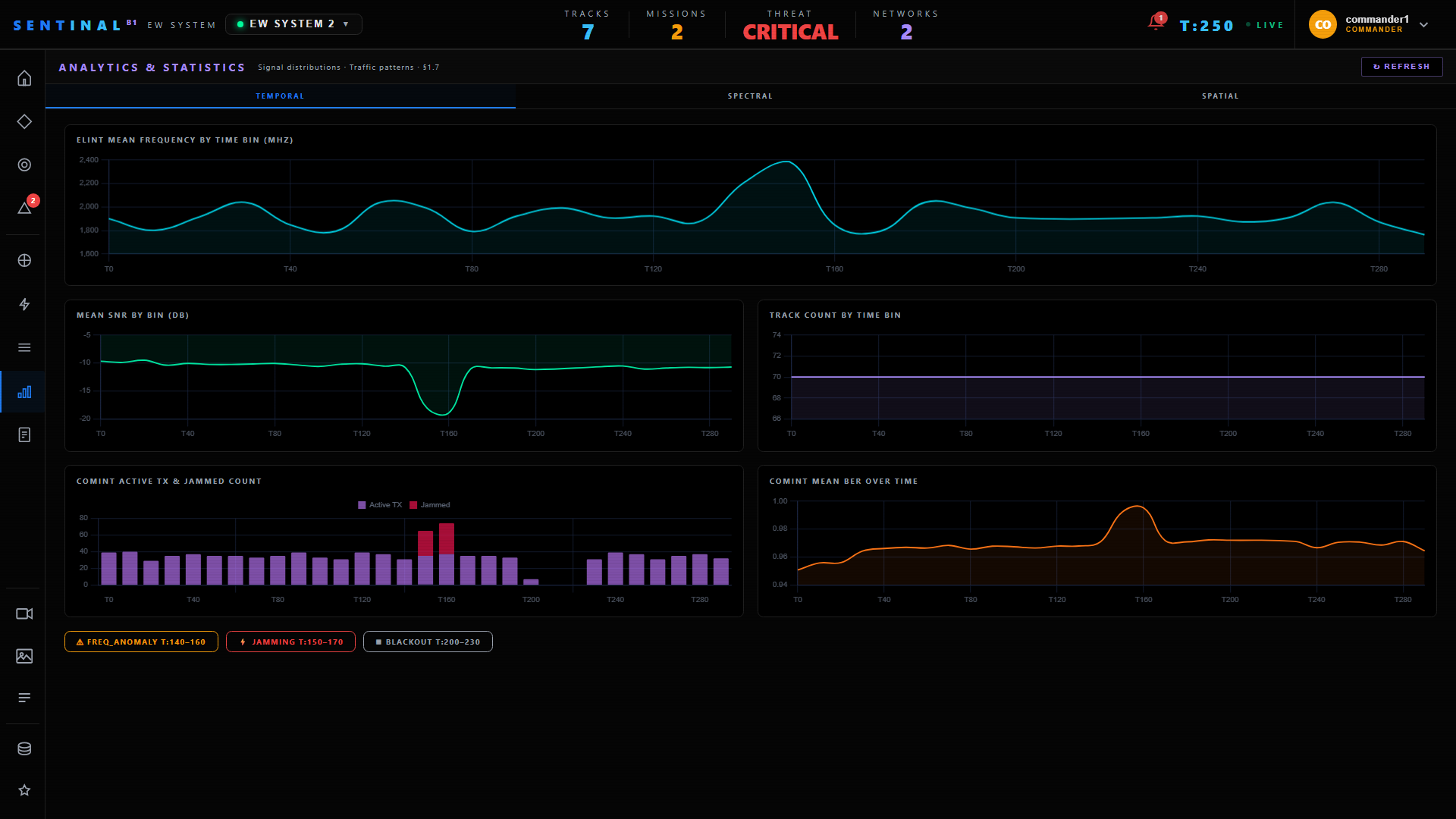
Statistics & Analytics Panel

05 — Machine Learning

Intelligence Engine Deep Dive

The Flask backend runs a 9-step processing pipeline over all 300 timesteps at startup, fusing raw RF sensor data into mission-level tactical intelligence.

STEP 01
Data Loading & Feature Extraction
CSV loaded into pandas, sorted by timestamp. COMINT version detected. StandardScaler fitted on CLUSTER_FEATURES for DBSCAN normalisation across frequency, PRI, pulse width, bandwidth, scan rate, duty cycle.
STEP 02
Sensor Fusion Window
5-timestep temporal window accumulates PDWs from t-4 to t, increasing available pulse descriptors and reducing false negatives for low-PRF radars that may not trigger every timestep.
STEP 03
DBSCAN Clustering
Groups PDWs into emitter clusters using density-based clustering on normalised feature space. Points labelled -1 (noise) are discarded. Each cluster represents one radar emitter.
eps=0.3 | min_samples=3 | noise_label=-1
STEP 04
Random Forest Classification
300 decision trees classify each cluster from 9 PDW features. Returns radar_type (0-3), confidence (0-100%), and human-readable radar_name. Platform_type intentionally excluded to simulate blind real-world classification.
n_estimators=300 | max_depth=20 | accuracy ≥ 95%
STEP 05
AoA Triangulation
Least-squares triangulation from multi-sensor angle-of-arrival measurements estimates 2D emitter position. AoA residual computed as a quality metric. Requires minimum 2 sensors per emitter cluster.
nx=-sin(AoA_i), ny=cos(AoA_i) — solve Ax=b
STEP 06
COMINT Block Processing
Agglomerative clustering groups emitters by comm_frequency (120 MHz threshold). Isolation Forest trained online during first 25 timesteps to learn COMINT feature baseline. Post-training: anomalous clusters flagged at score=-1.
STEP 07
Kalman Tracking
Constant-velocity Kalman filter maintains track continuity across timesteps with nearest-neighbour gating association within 15km (EW1) or 12km (EW2). State vector: [x, y, vx, vy].
Q=0.08 | R=2.0 | trail subsampled every 3rd frame
STEP 08
Mission Management
Three-stage pipeline: COMINT-based track grouping with 45km radius merging, rule-based mission type classification from entity composition, then weighted threat score formula mapping to 4 threat levels.
score = base + 0.12*jam + 0.08*anomaly + ...
STEP 09
Frame Cache & Persistence
Each processed timestep stored in in-memory frame_cache dictionary, then bulk-upserted to PostgreSQL using execute_values (page_size=200) for efficient write throughput.
System Architecture

Data Processing Pipeline

Real-time ingestion and transformation sequence converting raw RF pulse descriptors into mission-level actionable intelligence.

01 Kafka Stream → 02 DBSCAN Clustering
03 Random Forest → 04 Kalman Tracking
05 PostgreSQL Persistence
Model Evaluation

Classification Metrics

High-fidelity performance across four distinct radar emitter categories, validated against the secondary holdout dataset.

GS (Ground): 98.2%
Naval: 96.5%
AEW (Airborne): 94.1%
Fighter: 95.8%
Overall System Accuracy: ≥ 95%
Random Forest Classifier

9-Feature PDW Classification

Trained on EW1 data, generalises to EW2 — EW2 fighter PDW signatures were specifically tuned to match EW1 type-3 distribution during dataset design.

frequency | pri | pulse_width | bandwidth | scan_rate
duty_cycle | modulation_type | doppler | snr
→ radar_type in {0:GS, 1:Naval, 2:AEW, 3:Fighter}
Isolation Forest (Online)

Adaptive Anomaly Detection

Trains in real-time during the first 25 timesteps, establishing a COMINT baseline before switching to anomaly scoring mode for the remaining 275 frames.

learning_window=25 timesteps
anomaly trigger: NET_B freq drift at t=140-160
jamming trigger: SNR drop 5-12dB at t=150-170

06 — Mission Classification

10 Tactical Mission Types

The MissionManager classifies adversary group activity into named mission types based on entity composition, speed, COMINT activity, and jamming signatures.

STRIKE PACKAGE
Base Threat: 0.85
ELECTRONIC WARFARE
Base Threat: 0.78
FORCE PACKAGE
Base Threat: 0.70
COMBAT AIR PATROL
Base Threat: 0.62
AIR DEFENSE
Base Threat: 0.50
FIGHTER PATROL
Base Threat: 0.40
NAVAL OPERATION
Base Threat: 0.42
ISR SURVEILLANCE
Base Threat: 0.28
GROUND SURVEILLANCE
Base Threat: 0.22
UNKNOWN
Base Threat: 0.20

Threat Score Formula

score = base_threat(mission_type)
    + 0.12 x jamming_active
    + 0.08 x anomaly_detected
    + min(fighter_count x 0.05, 0.20)
    + min(avg_speed x 0.07, 0.10)
    + min((entity_count-1) x 0.025, 0.10)
    + heading_coherence x 0.06

Threat levels: LOW (<0.30) / MEDIUM (<0.55) / HIGH (<0.75) / CRITICAL (>=0.75)

07 — COMINT Events

Scripted Tactical Event Timeline

Three scripted events embedded in the simulation test the system's analytical robustness across the 300-timestep operational window.

Timestep
Event
Status
t = 140 - 160
Frequency Anomaly
NET_B drifts 600-1000 MHz above its normal UHF band. comm_anomaly flag set. Isolation Forest triggers anomaly detection alert.
ANOMALY
t = 150 - 170
Communications Jamming
NET_A and NET_B experience 5-12dB SNR degradation. comm_jammed=True. JAU computes jamming effectiveness and recovery time post-event.
JAMMED
t = 200 - 230
Communication Blackout
All COMINT networks go silent. comm_active=False across NET_A and NET_B. Dashboard COMINT panel shows zero active network nodes.
BLACKOUT
JAU Jamming Analysis — SNR Timeline
COMINT Network Cluster View

08 — Tech Stack

Technologies Used

A carefully selected set of technologies covering ML, streaming, backend API, database, computer vision, and NLP — no frontend frameworks used.

Backend
Flask
REST API — 50+ endpoints, CORS-first
ML
scikit-learn
Random Forest, Isolation Forest, DBSCAN, Agglomerative
Streaming
Apache Kafka
ew1.raw + ew2.raw topics, 20MB messages
Database
PostgreSQL
JSONB schema, bulk upsert, psycopg2
Computer Vision
YOLOv5
Object detection + Kalman Box Tracker
NLP
NLTK + VADER
NER, keywords, sentiment, clustering
Data
NumPy / Pandas
Feature engineering, simulation physics
Infra
Docker
Kafka + Zookeeper + Kafka UI containers
Video
OpenCV + ffmpeg
H.264 MP4, HTTP Range seeking
Frontend
Vanilla JS
Zero frameworks — pure HTML/CSS/JS
Tracking
SciPy
Hungarian algorithm for multi-object assignment
Model I/O
joblib
Radar classifier .pkl persistence + loading

09 — Deployment

7-Step Startup Guide

From cold start to fully operational tactical intelligence dashboard with live data flowing through every panel.

01
Start Kafka Infrastructure
Launch Kafka broker, Zookeeper, and Kafka UI on kafka-net Docker network. Wait 20-30 seconds. UI at :8080.
docker compose up -d
02
Generate Datasets
Run both generators to produce EW1 (~4800 rows) and EW2 (~14400 rows) CSV files with 300 timesteps of sensor data.
python datasetgeneration_v6_advancecomint.py
03
Train Classifier
First time only — trains Random Forest on EW1 PDW data. Saves radar_classifier_v2.pkl. Achieves 95%+ accuracy.
python train_classifier_v2.py
04
Stream via Kafka
Optional — publishes both CSV datasets to their respective topics, simulating real-time sensor feed ingestion.
python kafka_producer.py
05
Start Backend Server
Flask server starts on :5000 in adaptor-controlled mode — RAM empty until operator triggers ELT pipeline.
python elint_server_new.py
06
Run ELT via Adaptor
Open adaptor.html. Set API URL. Click Run ELT — triggers pg-reprocess (30-120s) then ingest/reload sequence.
open adaptor.html → Run ELT Pipeline
07
Access Dashboard
Open index.html. All 12 panels are live. Navigate 300 timesteps with manual stepping or auto-play mode.
open index.html
PYTHON
3.10+
DOCKER
Latest Desktop
POSTGRESQL
13+
FFMPEG
Optional (H.264)
NODE.JS
16+ (optional)

10 — Project Files

Complete File Index

.py
datasetgeneration_v6_advancecomint.py
EW System 1 generator — seed 42, 4 emitters, corner sensors, 300 timesteps
.py
data_generation_v9_EW2.py
EW System 2 generator — seed 99, 8 emitters including 3 mobile fighter jets
.py
train_classifier_v2.py
Random Forest radar classifier training — produces radar_classifier_v2.pkl
.py
kafka_producer.py
Streams CSV data to ew1.raw + ew2.raw Kafka topics with timestamp batching
.yml
docker-compose.yml
Kafka + Zookeeper + Kafka UI on kafka-net bridge with 20MB message limit
.py
elint_server_new.py
Main Flask intelligence API — full 9-step processing pipeline, 50+ endpoints
.py
media_blueprint.py
Flask Blueprint — YOLOv5 video detection, image analysis, NLP text intelligence
.html
adaptor.html
ICIC Interface Software — standalone ELT controller and status monitoring
.html
index.html
Tactical dashboard shell — 12 intelligence panels, timeline scrubber, auto-play
.css
style.css
Frontend CSS design system — dark military aesthetic, scanline CRT overlay
.js
script.js
Frontend application — REST API client, frame rendering, playback engine
.pkl
radar_classifier_v2.pkl
Trained Random Forest model loaded by backend at startup via joblib

11 — Limitations & Roadmap

Known Limitations & Planned Enhancements

Current Limitations

Synthetic Data Only — Simplified physics models; real deployment needs calibrated antenna patterns and multi-path propagation.
Single-Node Kafka — Replication factor 1; production deployment requires multi-broker cluster for fault tolerance.
In-Memory Mission State — MissionManager state not persisted between server restarts; mission IDs reset.
JIM/JIS Stubs — CDR analysis and IMSI tracking endpoints return simulated data pending classified input.
No Real-Time Kafka Consumer — Backend reads CSV directly; true streaming requires a live consumer thread.
Single-Threaded ELT — Sequential processing; parallelisation would significantly cut the 30-120s reprocess window.

Planned Enhancements

Real Kafka Consumer — True streaming intelligence pipeline with live sensor feed ingestion via consumer thread.
Multi-Hypothesis Tracking (MHT) — Handle track ambiguity in dense emitter environments without losing continuity.
Frequency Deinterleaving — Separate interleaved pulses from co-channel emitters sharing the same frequency band.
3D Position via ToA — Time-of-arrival multilateration to add altitude estimation alongside AoA triangulation.
BERT-Based NER — Higher NER accuracy on military text over NLTK's rule-based chunking approach.
GIS Integration — Real geographic coordinates, terrain overlays, and map tile integration for COP display.

12 — Glossary

Key Terminology

SENTINAL
Signal Intelligence and Electronic Warfare Analysis System — project codename
ELINT
Electronic Intelligence — from non-communication RF emissions (radar pulses)
COMINT
Communications Intelligence — from intercepted adversary communications networks
SIGINT
Signals Intelligence — umbrella covering all electromagnetic signal interception
PDW
Pulse Descriptor Word — measured parameters characterising a single radar pulse
AoA
Angle of Arrival — bearing angle measured from sensor to transmitter
COP
Common Operating Picture — unified situational awareness display for commanders
EOB
Electronic Order of Battle — per-emitter catalogue of adversary electronic assets
JAU
Jamming Analysis Unit — analyses COMINT jamming effectiveness and recovery time
FEBA
Forward Edge of the Battle Area — tactical boundary line rendered on the COP
AEW
Airborne Early Warning — high-altitude radar aircraft providing long-range detection
ELT
Extract Load Transform — the data pipeline controlled by the ICIC adaptor
REP
Recognized Electronic Picture — comprehensive view of the electromagnetic environment
DBSCAN
Density-Based Spatial Clustering of Applications with Noise — emitter grouping algorithm
ISR
Intelligence Surveillance and Reconnaissance — passive monitoring mission type
PRI
Pulse Repetition Interval — time between consecutive radar pulses, measured in microseconds
VADER
Valence Aware Dictionary and sEntiment Reasoner — NLP sentiment analysis tool
ICIC
Interface and Control — the adaptor software that authorises ELT pipeline execution